

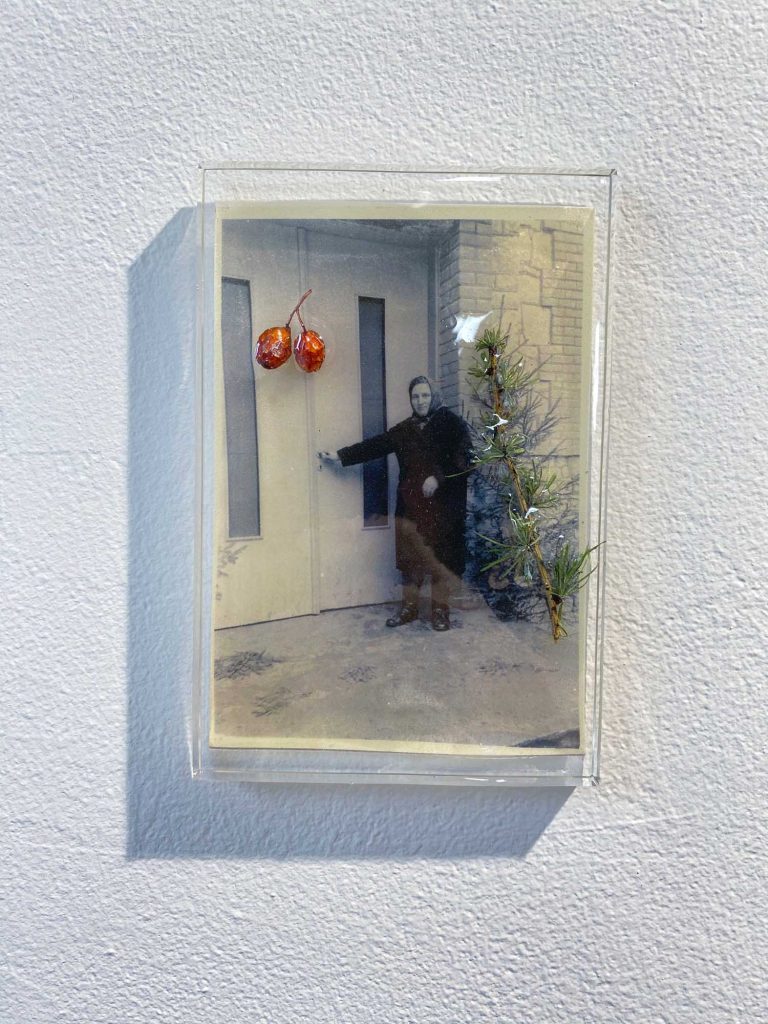
During the summer, artist Ikuru Kuwajima explored the landscape and history of the rural areas of the Ogre region. He undertook expeditions along the Daugava and Ogre rivers and searched for archival photographs in the region’s museums and libraries. The artist has visualised his research through works inspired by local tales and legends, using a combination of archival photographs, his own photographic material, and found objects. For example, the installation dedicated to the Ogre River features collages of linden leaves alongside photographs taken along the riverbank. This work refers to the legend “How Ogre Originated”, which tells of the river’s origin from a linden tree.
Several legends associated with the Daugava River and Ķente Hillfort, as well as Andrejs Pumpurs’ epic “Lāčplēsis” (Bear Slayer), have inspired Kuwajima’s other works. The exhibition presents both historical imagery and entirely new visual interpretations of the region.
Ikuru Kuwajima is an artist and photographer born in Japan. He was educated at a university in the United States and, since 2007, has lived and worked in various Eastern European and Central Asian countries. His artistic practice focuses on historical and social issues, primarily in post-Soviet regions, and includes photography, video, artist books, and installations. His works have been exhibited and published internationally. His books “Children of the Tundra” (2015, Vienna) and “I, Oblomov” (2017, Moscow) have received wide recognition. Kuwajima is also a Japanese–English–Russian–Ukrainian translator; he speaks French and a little Romanian.
Exhibition curator: Elīna Cērpa
Texts: Ikuru Kuwajima
Graphic design: Bumbierkoks
Text editing: Antra Lezdiņa
The exhibition features images from the archives of the Museum of the Occupation of Latvia.
Ogre History and Art Museum extends its thanks to: Velta Riekstiņa, Līksma Dzelme, Sarmīte Poikāne, Ingrīda Ķezbere, Dzintars Kvants, Vija Links & Aivars Links, Mirdza Jačino, Daiga Sosnare, Liene Kainaize, Lelde Neimane, Jūlija Berkoviča, the Meņģele branch of Taurupe Primary School, Edgars Kalnriekstiņš, Vita Gžibovska, Ilze Jankuna, the Inķēni family, Daiga and Andris Eklons, Dāvids Zaķis, and Irisa Janēvica.