
Soviet-era Dolls Enrich the Museum’s Collection
Recently, the collection of the Ogre History and Art Museum has been enriched with significant artefacts from the Soviet era. Ogre resident Kristīna Apine (née Lielbriede) donated her childhood playmates to the museum – four dolls, a rubber chicken, and the mascot bear of the Moscow Olympic Games. Remarkably, all of these 40-year-old toys appear […]
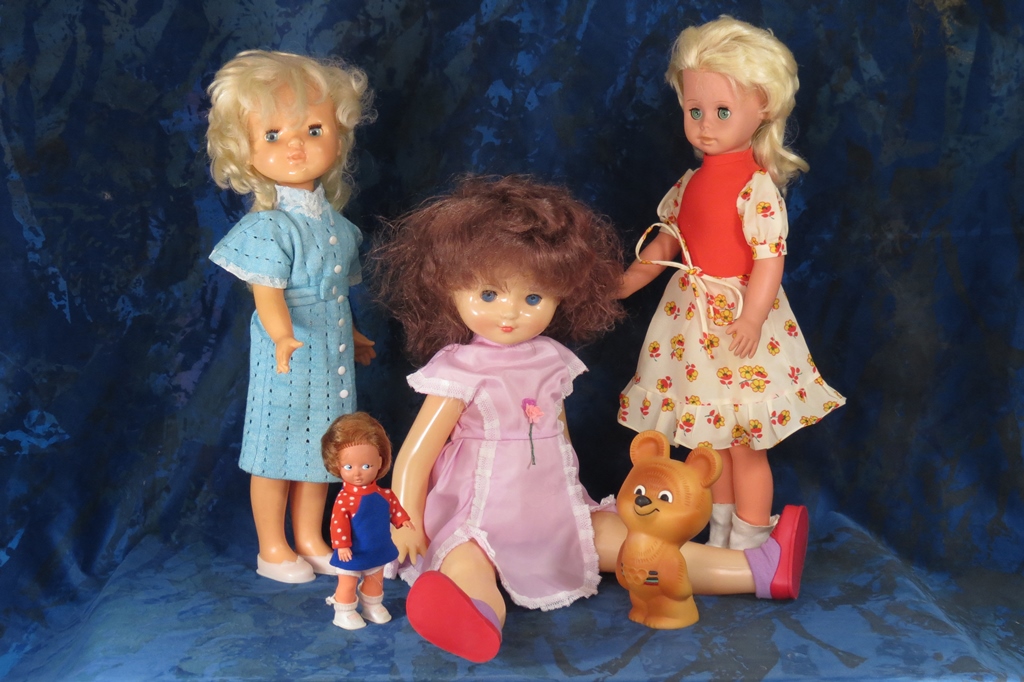
Recently, the collection of the Ogre History and Art Museum has been enriched with significant artefacts from the Soviet era. Ogre resident Kristīna Apine (née Lielbriede) donated her childhood playmates to the museum – four dolls, a rubber chicken, and the mascot bear of the Moscow Olympic Games. Remarkably, all of these 40-year-old toys appear as if they have just come off a store shelf.
Kristīna Apine: “In my childhood, I had many toys – soft toys and various dolls. My father worked as a chief engineer at the well-known ‘Sakta’ store in Riga, and this position was, of course, considered very good during Soviet times. I also had dolls that he brought back from his business trips abroad. I remember my parents always taught me to treat my dolls with love. I never had all the toys I owned at my disposal, because my parents figured out which ones I liked best, left those out, and put the rest in the top compartment of the wall unit. After half a year, they would take them out again, and they seemed new to me.”
Three of the dolls Kristīna Apine donated to the museum still have their original clothing. However, Kristīna notes that she particularly enjoyed making clothes for her dolls herself. Her grandmother, Vilhelmīne Magazniece (née Villeruša), was a skilled needlewoman and taught Kristīna many of her techniques.
In the apartment on Padomju Avenue (now Mālkalnes Avenue) where the Lielbriede family lived, there was a substantial collection of “Atpūta” magazines on the bookshelf. As a child, Kristīna was captivated by the beautiful and feminine clothing designs she saw there. Later, many of her dolls were dressed in clothing inspired by the 1920s and 1930s.
Although the dolls Kristīna Apine donated to the museum are perfectly preserved, she admits that she played with them wholeheartedly. Like children, her dolls also “fell ill” and wanted to be beautiful. As a result, some had their hair cut, others were “injected” with a large glass syringe into their “veins” or had bandages applied, and almost all of the dolls had been in the bath – their hair washed and then wrapped in her mother Ināra’s metal rollers with elastic bands. Kristīna laughs, saying there were some “sacrifices of love” and the lives of these toys ended in the distant Soviet era.
The Ogre History and Art Museum thanks Kristīna Apine of Ogre for her donation.
This is a time when many Soviet-era artefacts have been discarded and lost to oblivion. Meanwhile, others that have found their way into preservation have lost the stories of their original owners. The greatest value of museum collection items lies in their stories – their testimonies – which most vividly create a connection to a specific era, revealing everyday life, daily routines, the people, and their lives.
Gunta Šmidre,
former Information Specialist of the Ogre History and Art Museum