
On May 16, 2025, the competition-exhibition “Artists of Ogre Region” was opened at the Ogre History and Art Museum.
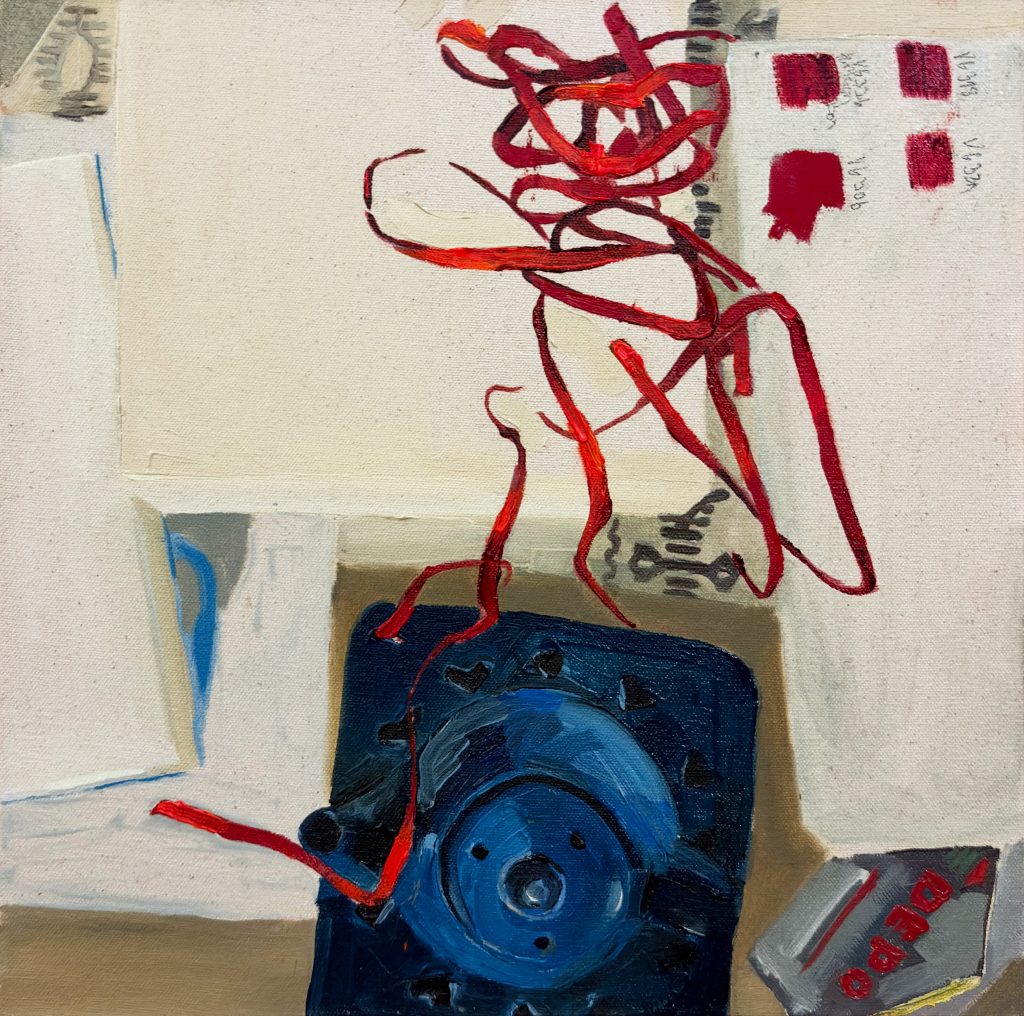
The winner of the exhibition “Artists of the Ogre Region” was Dārta Madara Cielava with the work “Grandpa Doesn’t Know My Name.” The recipient of the main prize earned the opportunity to hold a solo exhibition in 2026 in the museum’s Great Hall.
About her upcoming exhibition, the artist says:
“Everyday rhythm leaves its traces in the environment around us. The meaning of objects in life is no longer purely practical. Space is not just space. Within it, an object becomes a reference point of human attachment. It tells a story about its user and keeper, about habits, about socioeconomic status. Daily experiences leave their imprint on the environment we maintain around ourselves. It is a diary that holds what cannot be expressed in words. I am an anthropologist. I am a detective. I know myself differently. Perhaps it would be more accurate to say I know myself less than those who deduce, research, observe. You look at me like a bird locked in a cage through screens, paintings, and loudly declared theses in moments when I do not play along with the staged performance of my own persona.
I am a student; I have school, work, and home. And at home I also work—I paint, write, send endless chains of emails. Routine emerges from comfort and the combination of small problems and joys.
I am affected by expensive heating in a rental building; I am affected by foolish, thoughtless remarks made by people whose staged performances we are all subjected to. My bed is my safety—it is like the origin point of a coordinate plane. I am not untouchable; I am in a cage I have built myself. When I step out of it, a new act begins.”
In her works, the artist perceives each object as a sign or a word. Nothing is accidental. Compositions form naturally; the artist assigns them context, seeking correlations between the physical and its emotional foundation. There are not answers to everything—it is important to accept that.
The exhibition searches for the boundary between the personal and the public. The paintings become a place where silence and information overload collide, revealing how conditional and fluid our understanding of private space is today. The body of work forms a reflection on social structure, our mechanisms of adaptation, and the tension between the collective and the individual—creating a distinctive documentation of the era.
In the paintings, impasto brushstrokes and vivid colors interact with bare areas of linen canvas, allowing the detail-rich works to breathe. What remains unpainted stays in shadow; its existence is neither emphasized nor diminished. Within the overall context, it becomes an axis of balance—important, yet forgotten.
Although the artist is trained as a painter, more unconventional media often find their way into her works and collections. Materiality plays a significant role in her practice; every choice of technique and material is grounded in intention. Painting evolves into an ideological practice, becoming a language without attempting to confine itself strictly to a medium or a conventional form.
The exhibition will be open at the Ogre History and Art Museum from July 3.