
Porcelain Tea Set “Vita”
New acquisitions enter the museum’s collection in various ways. Most often, they are donations from individuals who no longer wish to keep certain items but, recognising their material or sentimental value, choose not to discard them. The museum’s new acquisition – a porcelain dinnerware set from the Riga Porcelain and Faience Factory – is certainly […]
New acquisitions enter the museum’s collection in various ways. Most often, they are donations from individuals who no longer wish to keep certain items but, recognising their material or sentimental value, choose not to discard them.
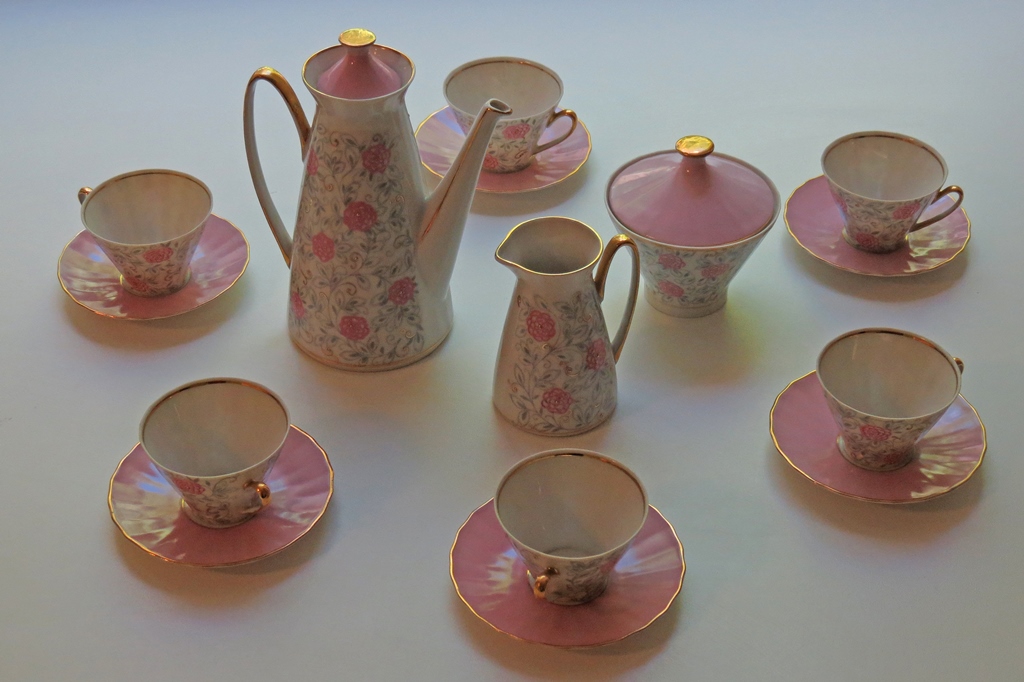
The museum’s new acquisition – a porcelain dinnerware set from the Riga Porcelain and Faience Factory – is certainly one such item, as it arrived at the museum from beside a waste bin next to an apartment building on Tīnūžu Street. We must thank the anonymous owner: instead of being discarded into a container, the dishes were carefully placed in a box and left next to the waste for disposal.
The “Vita” dinnerware set is an excellent addition to the museum’s collection. Its value is enhanced by the good condition of the pieces and the fact that almost the entire set has been preserved, including the main items: a coffee pot, a creamer, and a sugar bowl, all with their original lids, as well as six cups and seven saucers. Only the dessert plates are missing (these are larger than saucers, smooth, with a ribbed edge, usually white, and decorated with the same pattern as the pot and cups).
The differing number of cups and saucers suggests that the set was likely intended for a larger number of people. The set that arrived at the museum represents what has remained of the full collection over the decades. For this type of dinnerware, the so-called “trio” – a cup, saucer, and plate – could be purchased separately, either as a souvenir or to supplement an existing set. It is possible that, for practical reasons, the owner decided to keep the dessert plates, as they are larger and therefore more functional than saucers.
As Iliana Veinberga, Chief Curator of the Riga Porcelain Museum, helped to clarify, “the set dates from the early production stage, as the sugar bowl is still of the ‘old’ type, with an expanded top opening. Soon after this design was developed, production considerations led to the sugar bowl being made inverted – with a narrow top and a wide base.”
Therefore, the dinnerware set most likely dates to the late 20th century, although similar sets – featuring the inverted sugar bowl shape – were mass-produced throughout the 20th century. It is made of so-called thin-walled porcelain, which was widely used in the 20th century and became one of the factory’s specialties during this period. Various technologies were used in the production of the pieces: the coffee pot, creamer, sugar bowl and cups are cast, while the saucers are moulded.
Although we rarely consider it in our daily lives, behind every household item stands an artist, technologist, or designer whose hours of dedicated work are later transformed into tangible objects that shape our everyday lives, interiors, and aesthetic taste. The form of the “Vita” dinnerware set was created by Zina Ulste, a long-time designer at the Riga Porcelain Factory, while the décor was designed by artist Maija Zagrebajeva. With its various décor variations, “Vita” is one of the Riga Porcelain Factory’s most popular and longest-produced dinnerware forms.
Former History Specialist of Ogre History and Art Museum
Santa Šustere